
Fatal Vision® Products Aid Florida Police in Impaired Driving Prevention
Florida’s 2025 Officer of the Year uses Fatal Vision® Goggles and SIDNE® to make impaired driving prevention lessons real and hands on.
Reading time: 6 minutes
|
At a Glance
|
Jump to a section:
National Teen Driver Safety Week runs October 18 through 24, and it gives schools, school resource officers, and community programs a ready reason to put prevention on the calendar. Assemblies, community events, week-long series, and ongoing classroom activities all have a place in that week, and hands-on tools give each of them a shared experience to build the discussion around.
An observance week solves a problem that has nothing to do with content. Getting prevention programming onto a high school calendar means competing with testing windows, athletic schedules, and every other department that wants an assembly, and a named week on the national calendar is the easiest justification a driver education instructor or school resource officer has all year.
Schools and community programs deliver the week in the format that fits their students and their calendar. Many run a single assembly or community event, which puts the topic in front of a large group at once. Others spread activities across several class periods or build them into an ongoing classroom routine. Hands-on tools work in each of these formats, and the week gives every one of them a reason to start planning early.
A sixteen-year-old with a learner’s permit has no reference point for impairment. They have never driven impaired, they have probably never been a passenger with an impaired driver, and a fatality statistic describes something that happens to other people. Instruction gives them the facts, and a hands-on activity gives those facts something personal to attach to.
Participation changes what the instructor has to work with. A student who attempts a familiar task and finds it harder than expected has something concrete to discuss, and the students watching have seen it happen to a classmate as well as heard about it. That shared experience is what the activity adds to the instruction already in place. The discussion the instructor leads afterward is where the learning happens.
Impairment and distraction are two of the risks new drivers face, and speeding is a third. The Fatal Speeding® demonstration gives educators another hands-on way to address speeding alongside impairment and distraction, so one program can cover all three. Our video of the Fatal Speeding demonstration shows how it runs, and the Fatal Speeding® Program Kit and Event Kit are available in our Speeding Prevention & Awareness category.
For a different angle on the same problem, our post on drunk driving prevention ideas for high school educators covers four approaches a single teacher can run, and Racing Toward Driving Safety looks at how one presenter has structured high school sessions over fifteen years.
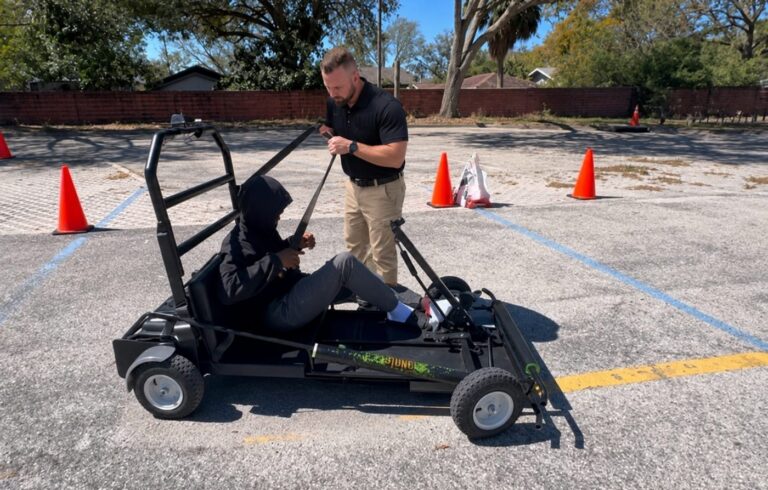
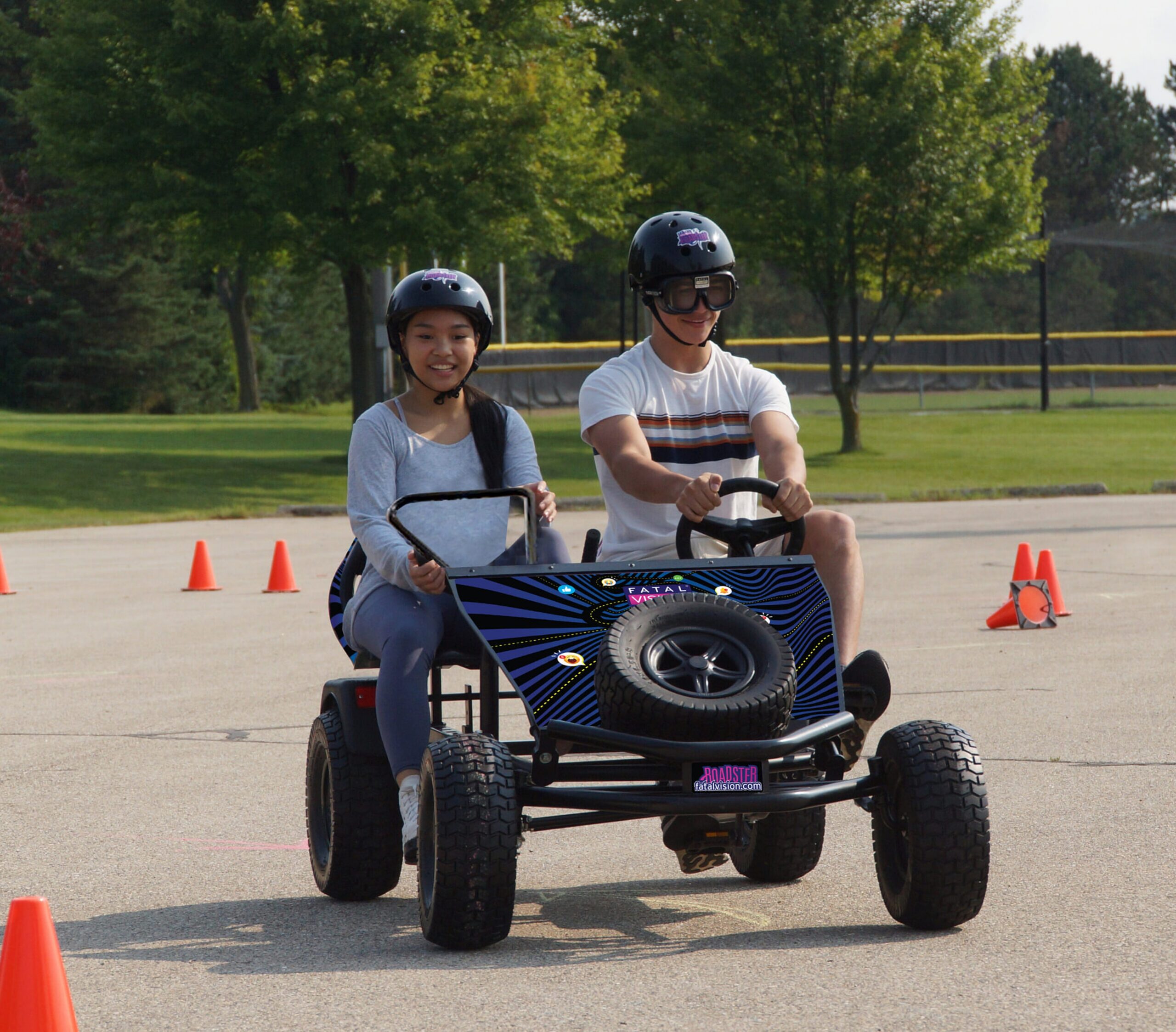
A high school drunk driving simulation is a controlled classroom activity in which a participant attempts an ordinary task while wearing goggles that simulate visual and coordination effects associated with alcohol impairment. The task is usually simple on purpose: walking a marked line, catching a tossed ball, sorting objects, or driving a pedal kart through a marked course with a facilitator alongside.
What it is not is worth stating to the group directly. A high school drunk driving simulation does not measure anyone’s tolerance, it does not reproduce what any individual would experience at a given blood alcohol level, and it is not a test anyone passes or fails. It is a demonstration that gives an instructor a shared reference for a conversation about reaction time, divided attention, and judgment.
Setting that expectation at the start also keeps the activity from drifting. Without it, a group tends to turn the demonstration into a contest, which is the opposite of what the session is for.
Programs deliver this week’s content in many formats, including single events, week-long series, ongoing classroom activities, and station rotations. A five-day structure with one 45-minute period a day is one example, and it adapts easily to other schedules. One possible version:
Group size is one of the main factors in choosing a format. A class of thirty cannot rotate through one station in a period, so programs either add a second facilitator for a parallel station or cover two class sections rather than five days of one. Programs that want to include speeding can add the Fatal Speeding® demonstration as another session in the week.
Working out what fits your class size, schedule, and space for Teen Driver Safety Week? Request a quote and our team can help you match the tools to your format.
October ends and the calendar moves on. A few things carry the topic into the rest of the year without needing another week:
It is a controlled classroom activity in which a student attempts an ordinary task, such as walking a line or driving a pedal kart through a marked course, while wearing goggles that simulate visual and coordination effects associated with alcohol impairment. It is a demonstration used to support discussion, not a measurement of any individual.
A demonstration with a small group and a guided discussion afterward fits inside a 45-minute class period. Larger classes are usually run as a station with students rotating through, which needs either more time or a second facilitator.
No. Schools run these activities through health classes, advisory periods, assemblies, and school resource officer visits. Driver education is the most natural fit because the students are already thinking about driving, but it is not a requirement.
Yes, and many programs move to peer facilitation after the first year. Our look at how a Michigan school district runs a peer-led impaired driving program covers how one district structured that handoff.
Fatal Vision® tools are designed to enhance and reinforce the driver education and prevention programming schools and school resource officers already deliver. They provide the hands-on component that supports the conversations instructors are leading.
Ready to build Teen Driver Safety Week programming for your students? Explore the Alcohol Goggles and program kits, the Fatal Speeding® Program Kit and Event Kit, request a quote for your program, or contact our team with questions about class size and setup. You can also browse our video library to see the activities in use, or visit our Funding & Grants page for resources to support an application.
Innocorp is the pioneering developer of Fatal Vision® Goggles and other hands-on impairment-awareness tools used globally by law enforcement, educators, and safety professionals.
Innocorp is the pioneering developer of Fatal Vision® Goggles and other hands-on impairment-awareness tools used globally by law enforcement, educators, and safety professionals.
We’d love to online chat! We are available Monday-Friday from 8am-5pm (CST):
Or schedule a time for a consultation:
Florida’s 2025 Officer of the Year uses Fatal Vision® Goggles and SIDNE® to make impaired driving prevention lessons real and hands on.

Reading time: 6 minutes At a Glance Why Thanksgiving, December gatherings, and New Year’s each bring their own outreach opportunities What polydrug use means, and why it comes up

Reading time: 6 minutes At a Glance Why the November clock change gives programs another timely reason to discuss drowsy driving What actually changes for drivers when the clocks