
Fatal Vision® Products Aid Florida Police in Impaired Driving Prevention
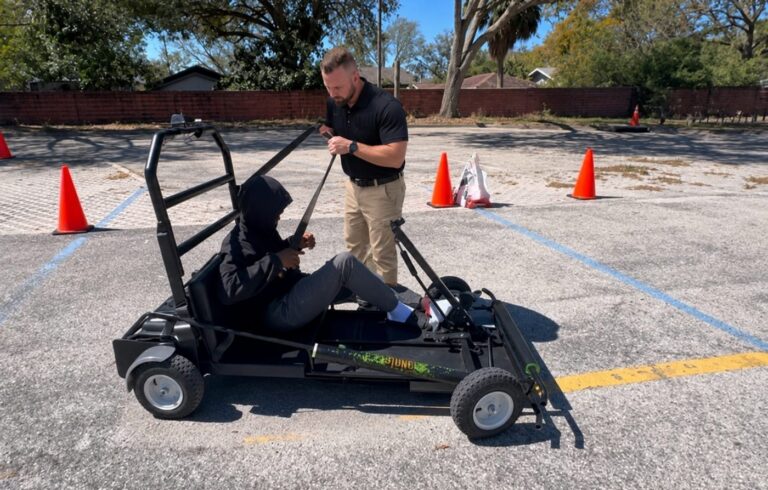
Florida’s 2025 Officer of the Year uses Fatal Vision® Goggles and SIDNE® to make impaired driving prevention lessons real and hands on.

Reading time: 6 minutes
|
At a Glance
|
Jump to a section:
Drowsy driving is a year-round concern, and safety programs, fleets, and campuses address it in every season. The first week of November adds another timely reason to talk about it. Drowsy Driving Prevention Week runs November 1 through 7, daylight saving time ends on November 1, and for the next several weeks a large share of the country drives home from work in the dark on disrupted sleep.
The calendar does something unusual here. An awareness week and a nationwide sleep disruption land in the same seven days, which gives programs a natural opening to bring fatigue into the conversation.
That matters for programming because a timely hook helps a session connect. Programs already address fatigue throughout the year, and the clock change gives facilitators one more concrete reference point: the week drivers are adjusting to a time change and finishing their routes in darkness is something they are experiencing firsthand.
It also helps with scheduling. Coordinators adding a fatigue session to a program already underway have a timely reason that needs little explanation.
Two things change at once, and they work in different directions.
The first is light. The evening commute moves into darkness almost overnight. Drivers who left work in daylight on Friday are driving home in the dark on Monday, and the visual environment is different in ways that take a few weeks to adjust to: headlight glare, reduced peripheral detail, and harder judgment of distance and closing speed.
The second is sleep timing. The hour gained in the autumn is usually described as the easy direction of the change, and for a single night it is. What follows is a shift in the relationship between clock time and body clock that takes most people several days to settle, on top of whatever sleep debt they were already carrying. Shift workers and early-start employees tend to feel it longest.
For a program, the useful framing is that the clock change is not itself the hazard. It is a predictable annual window where darkness and disrupted sleep overlap, which makes it a good moment to put the topic in front of people.
Fatigue degrades the same abilities impairment does. Reaction time lengthens, attention narrows, and the ability to track several things at once, traffic flow, mirrors, a changing signal, drops off. The specific failure that makes fatigue its own problem is the microsleep: a lapse of a few seconds during which the driver is not processing anything at all, often without realizing afterward that it happened.
The scale is hard to measure precisely, and NHTSA says so directly. Its most recent figure is 644 deaths from drowsy-driving-related crashes in 2024. Its broader 2017 estimate put police-reported crashes involving drowsy drivers at roughly 91,000, with about 50,000 injuries and close to 800 deaths, and NHTSA notes those numbers are likely underestimates, because fatigue leaves no roadside test behind.
Researchers frequently compare hours awake to blood alcohol levels as a way of making the effect legible to an audience. That comparison is worth a session of its own, and we cover it separately rather than compressing it here.
Adding fatigue to a curriculum does not mean building a new one. Most organizations attach it to something already scheduled:
If your program needs to identify which groups to prioritize, our post on identifying high-risk groups for drowsy driving covers shift workers, teen drivers, long-haul drivers, and medication-related drowsiness in detail.
Working out how a fatigue session fits your audience? Request a quote and our team can help you plan it.
Fatigue is a topic where experience adds a lot, because every adult in the room believes they know what being tired feels like and can manage it. A demonstration gives a facilitator something physical to discuss:
The facilitator note that matters most on this topic is that the goggles simulate effects associated with fatigue. They are an educational demonstration used to support discussion, not a measurement of anyone’s alertness.
Drowsy Driving Prevention Week runs November 1 through 7. In 2026 it begins the same day daylight saving time ends, which is why the clock change and the observance tend to be programmed together.
Two things shift at once. The evening commute moves into darkness, and the relationship between clock time and body clock takes several days to settle. The combination makes the first weeks of November a predictable window where darkness and disrupted sleep overlap.
Fatigue lengthens reaction time, narrows attention, and reduces the ability to monitor several things at once. It also produces microsleeps, brief lapses during which a driver processes nothing and often does not realize afterward that it happened.
Yes. A demonstration with a small group and a guided discussion afterward fits a 45-minute period or a standard safety meeting. Larger groups are usually run as a station with participants rotating through.
Fatal Vision® tools are designed to enhance and reinforce the safety programming schools, employers, and community organizations already deliver. They provide the hands-on component that supports the conversation a facilitator is leading.
For federal data and prevention material, start with NHTSA’s drowsy driving resources.
Ready to add a fatigue component to your programming? Explore the Drowsy & Distracted Driving Goggles, request a quote for your program, or contact our team with questions about audience and setting. You can also browse our video library to see the goggles in use, or visit our Funding & Grants page for resources to support an application.
Innocorp is the pioneering developer of Fatal Vision® Goggles and other hands-on impairment-awareness tools used globally by law enforcement, educators, and safety professionals.
Frequently Asked Questions
Drowsy Driving Prevention Week runs November 1 through 7. In 2026 it begins the same day daylight saving time ends, which is why the clock change and the observance tend to be programmed together.
Two things shift at once. The evening commute moves into darkness, and the relationship between clock time and body clock takes several days to settle. The combination makes the first weeks of November a predictable window where darkness and disrupted sleep overlap.
Fatigue lengthens reaction time, narrows attention, and reduces the ability to monitor several things at once. It also produces microsleeps, brief lapses during which a driver processes nothing and often does not realize afterward that it happened.
Yes. A demonstration with a small group and a guided discussion afterward fits a 45-minute period or a standard safety meeting. Larger groups are usually run as a station with participants rotating through.
Fatal Vision® tools are designed to enhance and reinforce the safety programming schools, employers, and community organizations already deliver. They provide the hands-on component that supports the conversation a facilitator is leading.
For federal data and prevention material, start with NHTSA’s drowsy driving resources.
Ready to add a fatigue component to your programming? Explore the Drowsy & Distracted Driving Goggles, request a quote for your program, or contact our team with questions about audience and setting. You can also browse our video library to see the goggles in use, or visit our Funding & Grants page for resources to support an application.
Innocorp is the pioneering developer of Fatal Vision® Goggles and other hands-on impairment-awareness tools used globally by law enforcement, educators, and safety professionals.
Innocorp is the pioneering developer of Fatal Vision® Goggles and other hands-on impairment-awareness tools used globally by law enforcement, educators, and safety professionals.
We’d love to online chat! We are available Monday-Friday from 8am-5pm (CST):
Or schedule a time for a consultation:
Florida’s 2025 Officer of the Year uses Fatal Vision® Goggles and SIDNE® to make impaired driving prevention lessons real and hands on.

Reading time: 6 minutes At a Glance Why Thanksgiving, December gatherings, and New Year’s each bring their own outreach opportunities What polydrug use means, and why it comes up
Reading time: 6 minutes At a Glance Why the observance week works as a planning prompt for schools and community programs What hands-on participation adds for a new driver,