
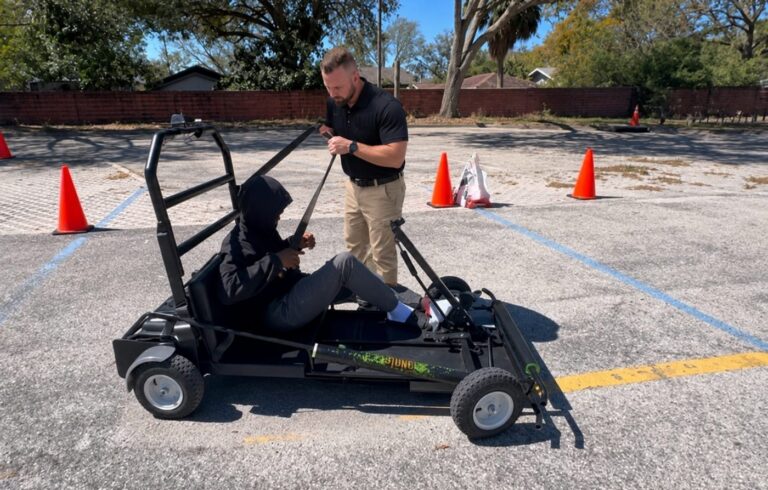
Fatal Vision® Products Aid Florida Police in Impaired Driving Prevention
Florida’s 2025 Officer of the Year uses Fatal Vision® Goggles and SIDNE® to make impaired driving prevention lessons real and hands on.

Reading time: 6 minutes
|
At a Glance
|
Jump to a section:
From Thanksgiving through New Year’s Eve, holiday travel and gatherings give impaired driving prevention programs a steady run of timely opportunities. Coalitions, departments, and campuses that plan outreach around these dates tend to settle on a location, line up volunteers, and arrange equipment a few weeks ahead, and the same plan can be adapted for each holiday in the season. The planning takes the most time. The event itself is straightforward.
The holiday season concentrates several things at once. Long-distance travel peaks, people drive unfamiliar routes in early darkness, and gatherings fill the calendar from Thanksgiving through New Year’s Eve. Certain nights draw particular attention from agencies, including the Wednesday before Thanksgiving, which many call Blackout Wednesday, and New Year’s Eve.
Programs approach the season in different ways. Some focus outreach on a single date, such as the week of Thanksgiving, while others schedule events across the season, with a presence before Thanksgiving, in mid-December, and ahead of New Year’s. Either approach reaches people while they are making travel plans, and hands-on activities give each event a way to start a conversation.
The audience changes across the season, too. Thanksgiving and winter break bring college students back to their hometowns, and community events and workplace gatherings reach working adults, so programs can match the format to the people they expect.
Polydrug use refers to more than one substance being present in a person’s system at the same time. The term is broad, and the effects vary considerably depending on which substances are involved.
The combination that comes up most often in holiday outreach, and the one our hands-on simulation tool is built to demonstrate, is alcohol and THC. Our polydrug education resources page covers the definitions, the research, and the activities in full, and the post on polydrug use risks goes into what the alcohol and THC interaction does to coordination and reaction time.
Holiday gatherings add a layer that prevention educators already work with. A gathering runs for hours, involves several households with different habits, and often includes both alcohol and, in states where it is legal, cannabis. Fatal Vision tools can enhance and reinforce the education programs already deliver by giving participants a hands-on way to experience the effects associated with combining alcohol and THC.
Two features of that setting matter for a program. The first is duration. Someone at a six-hour gathering is making a series of small decisions rather than one, and the drive home is decided at the end of it. The second is that self-assessment is the only measure most people have, and it is an unreliable one under any circumstances. A second substance adds another variable to an estimate that was already imprecise.
That is why many outreach events center on making a transportation plan in advance rather than at the end of the evening.
Working backward from the date of any holiday event, whether it falls before Thanksgiving, in mid-December, or ahead of New Year’s Eve:
The same timeline fits different program types. A campus station, a department open house, and a workplace safety meeting all follow the same sequence, with the location and group size changing the details.
A workable station set for a small team: Alcohol Goggles with a simple coordination task, Polydrug [Alcohol & THC] Goggles for the combined comparison, and a DIES® Activity Mat to give the walking task a defined surface. The Event Kit configurations are built for exactly this setting, where participants rotate through quickly.
One note to make at every station. The Polydrug Goggles simulate effects associated specifically with the combination of alcohol and THC. They do not model other substance pairings, and they are not an assessment of any individual. They are an educational simulation used to support the conversation.
For a fuller account of how a coalition organizes this kind of event, see our post on alcohol awareness programs and prevention tools.
Planning outreach for an upcoming holiday? Request a quote and our team can talk through timing.
The days before a campus holiday break, whether Thanksgiving or winter break, are a narrow and useful window. Students are still on site, they are about to travel, and many will spend the holiday in social settings with people they only see a few times a year.
What tends to work in that window:
Most coalitions and departments settle on a date and location about three weeks ahead of an event, which leaves time to confirm volunteers and get equipment in hand. The same timeline works for Thanksgiving, December gatherings, and New Year’s.
Polydrug use refers to more than one substance being present in a person’s system at the same time. The combination most relevant to holiday outreach, and the one our simulation tool demonstrates, is alcohol and THC.
A location with existing foot traffic, two or three stations, a trained facilitator at each, printed local resources, and a short debrief the facilitators can repeat all day. Participants arrive individually rather than as a group, so the format has to work in about ninety seconds.
No. They are engineered specifically to simulate visual and coordination effects associated with concurrent alcohol and THC use, and they do not simulate other drug combinations.
Fatal Vision® tools are designed to enhance and reinforce the impaired driving prevention programs coalitions, departments, and campuses already run. They provide the hands-on component that supports the conversations facilitators are having at the table.
For federal data and prevention material, start with the CDC’s impaired driving resources, and see SAMHSA Communities Talk: Tips and Resources for community prevention planning.
Planning outreach for the holiday season? Explore the Polydrug [Alcohol & THC] Goggles and Event Kits, request a quote for your program, or contact our team with questions about timing and setup. You can also browse our video library to see the goggles in use, or visit our Funding & Grants page for resources to support an application.
Innocorp is the pioneering developer of Fatal Vision® Goggles and other hands-on impairment-awareness tools used globally by law enforcement, educators, and safety professionals.
Innocorp is the pioneering developer of Fatal Vision® Goggles and other hands-on impairment-awareness tools used globally by law enforcement, educators, and safety professionals.
We’d love to online chat! We are available Monday-Friday from 8am-5pm (CST):
Or schedule a time for a consultation:
Florida’s 2025 Officer of the Year uses Fatal Vision® Goggles and SIDNE® to make impaired driving prevention lessons real and hands on.
Reading time: 6 minutes At a Glance Why the November clock change gives programs another timely reason to discuss drowsy driving What actually changes for drivers when the clocks
Reading time: 6 minutes At a Glance Why the observance week works as a planning prompt for schools and community programs What hands-on participation adds for a new driver,